
Current Issue
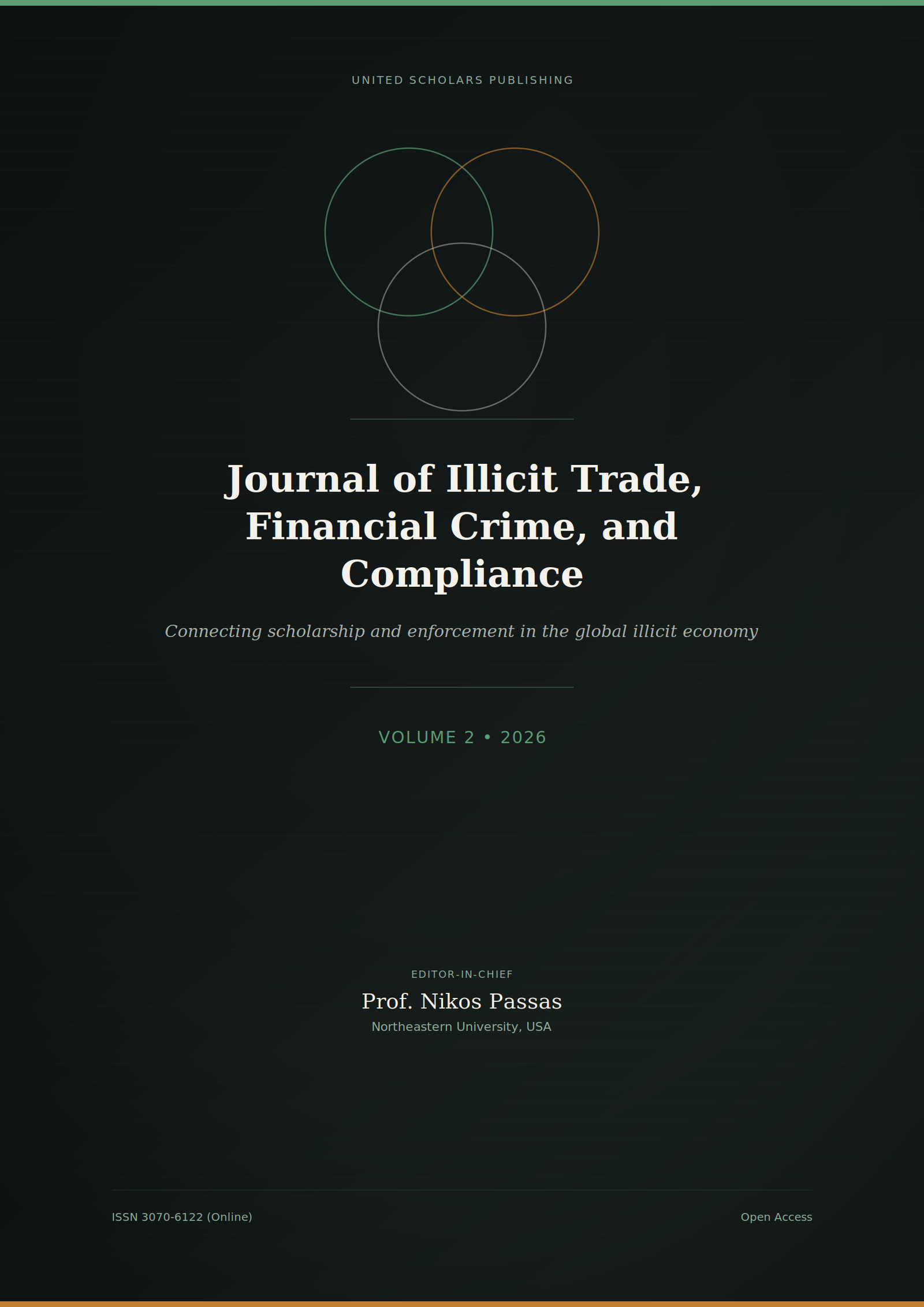
The Journal of Illicit Trade, Financial Crime, and Compliance (JITFCC) examines the evolving relationships between illicit markets, financial crime, regulation, and legitimate economic activity. Under the leadership of Professor Nikos Passas, the journal provides a scholarly forum for understanding how illicit trade and financial crime emerge, adapt, and operate across borders—and how laws, institutions, markets, and compliance systems respond to them.
JITFCC welcomes interdisciplinary research that moves beyond conventional boundaries between illicit trade, organized crime, financial crime, and regulatory compliance. We are particularly interested in work that illuminates the structures and mechanisms through which illicit activities are enabled, concealed, facilitated, or regulated, as well as research that critically examines the effectiveness and unintended consequences of regulatory and enforcement responses.
The journal brings together scholarship and informed perspectives from criminology, law, economics, finance, public policy, and related fields, with the aim of fostering a deeper understanding of contemporary illicit economies and the challenges they present to governments, businesses, financial institutions, and society.
Articles
The Journal of Illicit Trade, Financial Crime, and Compliance (JITFCC) is an international, peer-reviewed, open-access journal dedicated to advancing scholarly research, policy analysis, and professional practice on the prevention, detection, regulation, and enforcement of illicit trade, financial crime, and regulatory compliance. Under the leadership of Prof. Passas JITFCC publishes rigorous interdisciplinary scholarship that explores the causes, consequences, prevention, and governance of illicit trade, financial crime, and regulatory compliance within national, regional, and global contexts. The journal will also bridge theory and practice in combating transnational financial crimes.
Aims and Scope
The JITFCC will focus on three core areas:
Illicit Trade
- Smuggling and counterfeit goods
- Human trafficking and modern slavery
- Narcotics and illegal arms trade
- Environmental crimes (wildlife trafficking, illegal logging)
Financial Crime
- Money laundering and terrorist financing
- Fraud (cyberfraud, corporate fraud, investment scams)
- Corruption and bribery (with focus on transnational cases)
- Tax evasion, offshore financial secrecy, and illicit flows
Compliance and Enforcement
- Anti-money laundering (AML) and counter-terrorist financing (CTF)
- Sanctions and export controls
- Corporate governance and ethical business practices
- Public-private partnerships in crime prevention
Journal Affiliation & Leadership
The JITFCC will be formally affiliated with the Anti-Corruption Academy of India (ACA), India's premier institution for anti-corruption education and research, where Editor-in-Chief Professor Nikos Passas serves as Chair of the Academic Council. This partnership will:
- Provide institutional support and global credibility
- Facilitate engagement with policymakers and enforcement agencies
- Enable access to ACA's network of anti-corruption experts
- Support special issues on emerging Asian and global corruption trends
JUSTIFICATION FOR THE JOURNAL
Escalating Global Threats
Illicit trade accounts for nearly 3% of global GDP (OECD), while financial crime costs economies trillions annually(UNODC).
Policy-Relevant Research
Existing journals lack focus on practical enforcement solutions. JITFCC will bridge this gap, esp. in light the suggested ACA partnership.
Unique Editorial Leadership
Professor Passas brings unparalleled expertise through his roles at:
- Northeastern University (Professor of Criminology)
- Anti-Corruption Academy of India (Academic Council Chair)
- UNODC, World Bank, OECD, Council of Europe, EU, UN Security Council, IMF, and FATF (consultant)
Target Audience
- Academics (criminology, law, economics)
- Policymakers (FATF, FinCEN, EU Commission)
- Financial institutions & compliance officers
- Law enforcement (Interpol, Europol, CBI)
- International organizations (UNODC, World Bank)
Publication Model
- Open Access with institutional support from ACA
- Double-blind peer review
- Digital-first with print option (re-print on request)
Expected Impact
- Enhance global understanding of illicit financial flows
- Influence anti-corruption policy through ACA's government connections
- Foster Asia-focused research on financial crime
Conclusion
The JITFCC, under Prof. Passas's leadership and ACA's institutional support, will become the definitive forum for research on illicit finance and compliance. We invite partnerships to launch this critical initiative.